China Top 10 Contemporary Garage Door Manufacturers
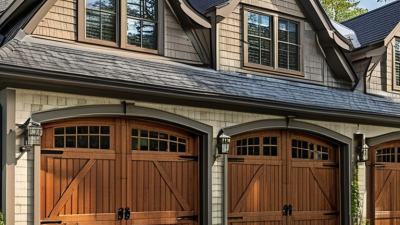
Contemporary garage doors have become a visible part of a home’s architecture, not merely a way to secure a vehicle. Their materials, proportions, glazing, and finish shape the street-facing impression. Architect Frank Lloyd Wright’s principle, “Form and function should be one,” offers a useful lens for evaluating them. It is not a garage-door industry quotation, but it captures the balance buyers should look for: a door must suit the building and perform reliably through daily use.
China’s manufacturers offer a wide range of contemporary garage doors, from clean-lined aluminum designs to insulated steel panels with restrained wood-grain finishes. Product details matter. Look closely at panel alignment, weather seals, track hardware, finish consistency, and the feel of the door in motion. A striking showroom sample may not reveal how the full installation handles wind, temperature changes, or repeated opening cycles.
This guide introduces ten Chinese manufacturers and compares their design ranges, production capabilities, customization options, and quality signals. The aim is practical, not promotional. Specifications and service can vary by model and supplier, so buyers should request current product data, warranty terms, and project references before making a decision. Small details count. A quiet motor helps, but so does a well-fitted seal on a rainy evening.
China’s Contemporary Garage Door Manufacturing Landscape
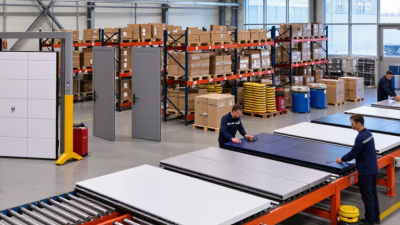
China’s contemporary garage door manufacturing landscape is shaped by varied climates, building types, and project budgets. Factories commonly work with steel, aluminum, insulated panels, and glass, adapting designs for homes, shops, and commercial sites. Customization matters. Opening size, wind exposure, insulation needs, and available headroom can influence specifications more than appearance alone. Reliable production depends on panel alignment, balanced springs, consistent coating, and careful movement testing. These details are easy to overlook.
Manufacturers increasingly pair contemporary finishes with practical features such as quiet drive systems, sectional layouts, and narrow-view glazing. Some projects also require smart controls, but compatibility and dependable manual operation deserve equal attention. Not every upgrade pays off. Buyers and specifiers can compare cycle-test records, material thickness, insulation values, installation guidance, and spare-part availability. A polished sample is useful, yet it cannot show how a door performs after repeated use or in damp air.
The market is broad, but quality can vary between product lines and production batches. That gap is real. Clear drawings, factory inspection records, and straightforward warranty terms help reduce uncertainty before shipment. Installer feedback can reveal small problems early, such as uneven seals or slow controls. Sometimes specifications still need revision after site measurements are confirmed; this is ordinary, not a failure.
China Top 10 Contemporary Garage Door Manufacturers - China’s Contemporary Garage Door Manufacturing Landscape
This overview compares ten common product and capability segments found in the contemporary garage door market. It is not a verified ranking of individual manufacturers; company names and brands are intentionally omitted. Specifications and availability vary by supplier and model.
| No. | Product or Capability Segment | Common Materials and Construction | Typical Applications | Key Evaluation Factors |
|---|---|---|---|---|
| 1 | Insulated sectional doors | Panel sections commonly use steel skins with an insulated core; panel design and insulation levels vary by model. | Residential garages and other buildings where thermal performance and a compact opening path are priorities. | Panel construction, insulation data, perimeter seals, hardware quality, and suitability for the local climate. |
| 2 | Non-insulated sectional doors | Sectional panels are commonly made from formed steel or other door-panel materials, with insulation omitted. | Garages and utility spaces where basic enclosure and operating function are more important than thermal insulation. | Panel rigidity, finish durability, operating hardware, wind requirements, and maintenance needs. |
| 3 | Roller shutter doors | Interlocking slats, often metal, travel vertically and coil into a compact enclosure above the opening. | Garages and commercial openings where overhead clearance is limited. | Slat profile, curtain guidance, locking options, motor compatibility, and access for servicing. |
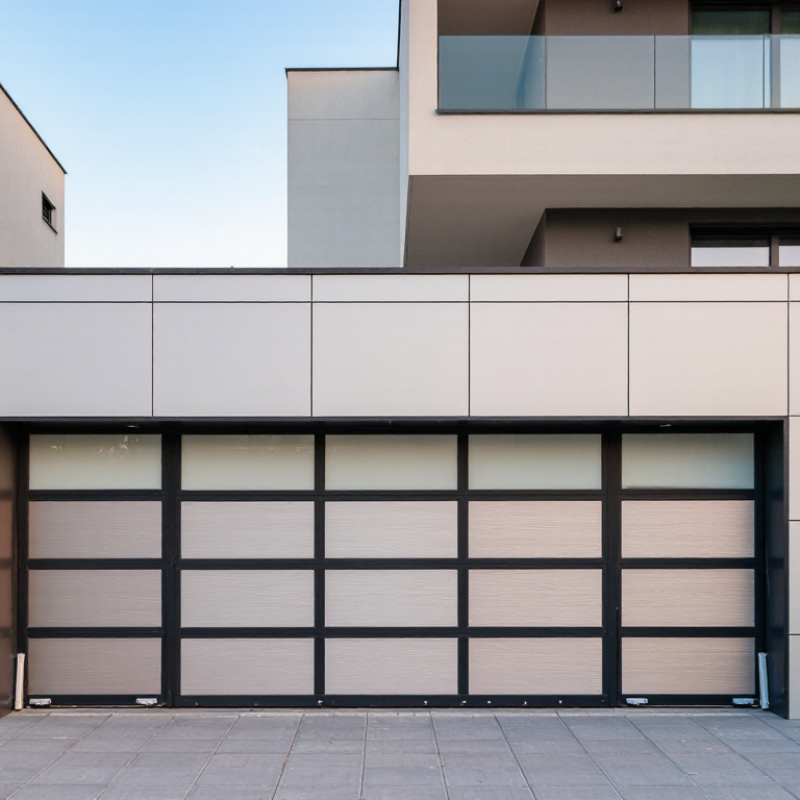
| 4 | Aluminum-and-glass sectional doors | Framed sections combine aluminum profiles with glazing; glazing type and frame finish are configurable. | Contemporary homes, showrooms, and spaces where daylight and visual transparency are desired. | Glazing safety, frame strength, weather sealing, privacy requirements, and cleaning access. |
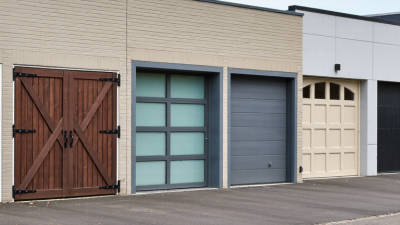
| 5 | Side-hinged garage doors | One or two hinged leaves are typically built with steel, aluminum, timber, or composite panels. | Garages where frequent pedestrian access or a traditional outward-opening arrangement is preferred. | Available swing clearance, hinge and frame strength, weather seals, security, and threshold details. |
| 6 | Up-and-over and tilt-up doors | A single rigid panel moves outward and upward, using a counterbalanced mechanism. | Residential garages with a compatible opening and adequate space in front of the door. | Driveway clearance, mechanism design, panel material, safety features, and opening dimensions. |
| 7 | High-cycle commercial sectional doors | Sectional construction is paired with hardware and operating components selected for more frequent use. | Workshops, service facilities, and commercial buildings with regular vehicle access. | Declared cycle rating, spring and track design, service access, operator compatibility, and safety devices. |
| 8 | Fire-rated industrial doors | Specialized door assemblies are designed and tested for specified fire-resistance performance. | Buildings where fire-compartmentation requirements call for a rated opening closure. | Applicable test and certification documents, permitted opening size, installation requirements, and inspection schedule. |
| 9 | Wind-load and impact-oriented doors | Door panels, tracks, and reinforcement are configured to meet project-specific environmental requirements. | Locations exposed to stronger winds or where local building rules specify enhanced door performance. | Verified design pressure or test information, opening dimensions, anchoring details, and local code compliance. |
| 10 | Custom-finish and project-specific doors | Standard door systems may be adapted with selected colors, surface finishes, glazing, dimensions, or hardware. | Architectural projects and replacement work requiring coordination with the building façade or existing opening. | Shop drawings, finish samples, dimensional tolerances, lead time, installation coordination, and warranty terms. |