
China Top FRP Pipe Manufacturers for Global Buyers?

Choosing China’s top FRP Pipe manufacturers requires more than comparing prices or browsing polished websites. Global buyers need evidence from the factory floor: resin systems, glass-fiber winding methods, pressure ratings, dimensional control, and documented testing. A reliable supplier should explain how each pipe performs in water treatment, chemical processing, irrigation, or industrial drainage. Samples, inspection records, and traceable material certificates can reveal more than a sales presentation.

Dr. V. M. Malhotra, a respected composites researcher, has stated, “The properties of a composite depend on the properties of its constituents and their interaction.” This principle remains practical when evaluating FRP Pipe producers. A strong resin may fail when fiber placement is inconsistent. Good reinforcement may underperform when curing conditions are poorly controlled. Experience matters here. Ask how the manufacturer handles joint design, UV exposure, installation tolerances, and long-term corrosion resistance.

No supplier ranking is perfect. Some manufacturers have excellent production equipment but limited export support. Others communicate well but provide weak technical evidence. That uncertainty deserves attention. Buyers should compare factory audits, project references, inspection procedures, warranty terms, and after-sales response times. Check the details.

This guide introduces China’s leading FRP Pipe manufacturers through a practical, evidence-based lens. It considers manufacturing capability, customization, certification awareness, delivery reliability, and field experience. The goal is not to promote the loudest company. It is to help buyers identify a dependable partner for safe, durable, and properly specified piping systems. Mistakes can happen. Careful verification reduces their cost.
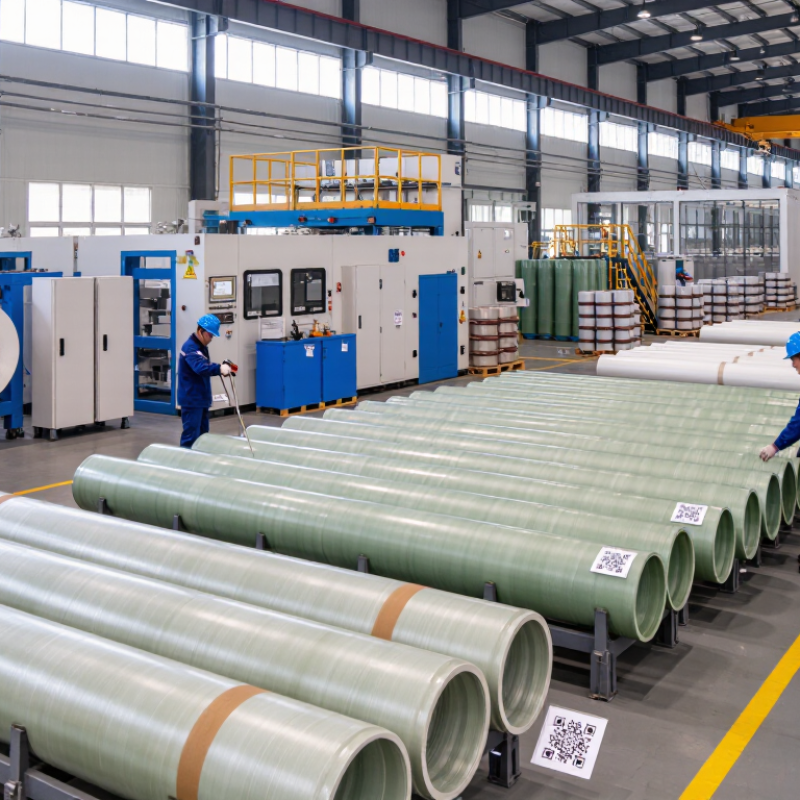
China Top FRP Pipe Manufacturers for Global Buyers?

What FRP Pipes Are and Where They Are Used

What FRP Pipes Are and Where They Are Used

Fiberglass reinforced plastic (FRP) pipes combine glass fibers with a resin matrix. The fibers provide strength, while the resin protects against water, chemicals, and corrosion. Unlike steel, FRP does not rust when exposed to many aggressive fluids. Its smooth inner surface can also reduce friction and energy loss during pumping. Manufacturing methods include filament winding, centrifugal casting, and hand lay-up. Each method affects wall thickness, pressure performance, and quality consistency.

FRP pipes are used in desalination plants, wastewater systems, chemical facilities, mining sites, and industrial cooling networks. They can carry seawater, brine, acids, and treated wastewater when the resin matches the fluid. Large-diameter sections are especially useful for water transmission because they are relatively light and easier to handle than metal pipes. On a real project, installers must still check lifting points, joint alignment, burial depth, and support spacing. Small errors can create stress at connections.

Not every FRP pipe suits every service. High temperatures, sudden pressure changes, ultraviolet exposure, and abrasive solids may shorten its life. I have seen specifications focus on corrosion resistance while overlooking temperature cycling. That is a costly gap. Buyers should request pressure ratings, resin information, test records, dimensional tolerances, and installation guidance. Independent inspection can improve confidence, although it adds time and expense. The practical choice depends on fluid chemistry, operating pressure, soil conditions, and maintenance access.

How China’s FRP Pipe Manufacturing Industry Is Structured

China Top FRP Pipe Manufacturers for Global Buyers?

How China’s FRP Pipe Manufacturing Industry Is Structured

China’s FRP pipe industry is organized around a broad upstream supply base. Fiberglass, resin, curing agents, and winding equipment come from specialized producers. The China Fiberglass Industry Association reported national glass-fiber output above 6 million tonnes in 2023. Only a portion enters pipe production, but this scale supports competitive material sourcing.

Downstream manufacturers usually fall into three groups: large integrated factories, regional specialists, and project-focused workshops. Integrated factories often control filament winding, centrifugal casting, filament placement, machining, and testing. Regional specialists may focus on water treatment, chemical drainage, or irrigation systems. Project-focused suppliers usually adjust pipe diameter, stiffness, joint design, and liner composition for one installation.

The structure creates useful flexibility for global buyers. MarketsandMarkets has projected steady growth in the global FRP pipe market through 2028, driven by corrosion resistance and lower maintenance needs. Yet public Chinese production data remains fragmented. That matters. A factory may show impressive equipment, while its inspection records remain thin. Experienced buyers should request resin specifications, hydrostatic test results, dimensional reports, and batch traceability. A sample pipe should be checked for surface porosity, uneven wall thickness, and weak socket joints. Small defects become expensive underground. Supplier capability is also uneven across provinces, and factory audits can reveal gaps that catalogs hide. The industry is mature in capacity, but not perfectly consistent in execution.

China Top FRP Pipe Manufacturers for Global Buyers? – How China’s FRP Pipe Manufacturing Industry Is Structured
Industry Dimension Typical Structure or Data What Global Buyers Should Evaluate Common Technical Reference
Core Product Categories Pressure pipes, non-pressure gravity-flow pipes, sewer and drainage pipes, water-treatment pipes, chemical-process pipes, and cable-protection conduits. Confirm whether the manufacturer specializes in pressure service, buried infrastructure, above-ground process piping, or custom non-standard components. Project specifications, design pressure, installation method, and applicable national or international standards.
Primary Reinforcement Continuous glass fiber is the dominant reinforcement. E-glass is widely used because of its balance of tensile strength, availability, and cost. Request the glass-fiber type, reinforcement architecture, winding angle, fiber content, and traceability documentation. Manufacturer technical datasheet and batch-level material records.
Resin Systems Unsaturated polyester resin is common for general water and drainage applications. Vinyl ester resin is typically selected for higher chemical resistance. Epoxy resin is used where specific mechanical or chemical-performance requirements justify its cost. Match the resin to temperature, pH, chemical concentration, immersion time, and expected service life. Resin supplier technical data, chemical-resistance charts, and project design criteria.
Main Manufacturing Process Filament winding is the principal process for many structural FRP pipes. Centrifugal casting is also used for certain pipe constructions, while hand lay-up is more common for fittings, flanges, manholes, and customized components. Check whether the process is automated, how winding tension is controlled, and whether production parameters are recorded digitally. Process qualification records, winding procedures, and inspection plans.
Typical Pipe Construction A common structure consists of an inner corrosion barrier, a structural laminate containing glass reinforcement, and an external surface layer for environmental protection. Verify liner thickness, resin-rich layer quality, structural wall design, exterior UV protection, and compatibility with the installation environment. Design drawings, laminate schedule, and cross-sectional inspection reports.
Nominal Diameter Range FRP pipes are manufactured in small diameters for industrial systems and large diameters for municipal water, wastewater, irrigation, and intake projects. Large-diameter products are commonly produced in project-specific sizes. Confirm the actual inside diameter, outside diameter, dimensional tolerances, joint dimensions, and transport limitations before ordering. Approved dimensional drawings and project-specific manufacturing tolerances.
Pressure Classification Pressure-rated FRP pipes are commonly supplied in defined pressure classes. The available classes depend on diameter, wall structure, resin system, and design code rather than on diameter alone. Compare allowable operating pressure, surge pressure, test pressure, vacuum rating, and temperature derating. AWWA C950, ISO 10639, EN 1796, or the specified project design standard.
Stiffness Classification Buried FRP pipes are designed for ring stiffness to resist soil and traffic loads. Common stiffness designations are expressed in N/m², with the required class determined by burial depth and installation conditions. Evaluate soil type, trench width, groundwater, bedding quality, traffic loading, and installation workmanship—not only the nominal stiffness value. ISO 7685, AWWA C950, structural calculations, and installation manuals.
Jointing Systems Common joint types include elastomeric gasket joints, sleeve couplings, butt-and-wrap joints, flanged connections, and laminated field joints. Select the joint according to pressure, axial movement, angular deflection, field conditions, maintenance requirements, and installation skill. Joint design drawings, gasket specifications, and approved installation procedures.
Applicable Standards Chinese production may be aligned with GB/T standards, while export projects may require ISO, ASTM, AWWA, EN, or customer-specific specifications. Define the governing standard in the purchase contract and ensure that testing, tolerances, marking, and acceptance criteria use the same standard. GB/T 21238, AWWA C950, ASTM D2996, ASTM D2997, ISO 10639, and EN 1796, where applicable.
Quality-Control Structure Typical controls include incoming-resin inspection, glass-fiber verification, dimensional checks, visual inspection, hydrostatic testing, stiffness testing, and destructive laminate testing. Ask for inspection and test plans, calibration records, nonconformance procedures, sample reports, and third-party inspection access. Approved quality plan, factory acceptance test procedure, and certificate of conformity.
Performance Testing Depending on the application, testing can include hydrostatic pressure, stiffness, axial tensile strength, ring deflection, leakage, joint performance, and chemical-resistance evaluation. Ensure the proposed tests represent the finished pipe, including joints and fittings where they are part of the supply scope. Relevant product standard, project specification, and independently witnessed test records.
Fittings and Accessories Manufacturers may supply elbows, tees, reducers, flanges, couplings, manholes, saddles, and repair components together with straight pipe. Confirm whether fittings are manufactured in-house or sourced separately, and require consistent pressure, stiffness, resin, and dimensional specifications. Fitting drawings, laminate schedules, and connection compatibility records.
Export Packaging and Logistics FRP pipes are lightweight compared with many metallic alternatives, but long lengths and large diameters require careful support, stacking, lifting, and container or break-bulk planning. Review pipe-length options, loading plans, lifting points, protection against impact, moisture, UV exposure, and port handling risks. Packing list, loading photographs, lifting instructions, and shipping marks.
Buyer Qualification Indicators Strong suppliers normally demonstrate documented design capability, stable production capacity, standard-compliant testing, experienced technical staff, and references for comparable applications. Evaluate technical documentation and verified project experience rather than relying only on catalog size, quoted price, or stated production capacity. Factory audit, reference-project verification, sample approval, and pre-shipment inspection.
Commercial Comparison Factors Total cost depends on resin system, pressure and stiffness class, diameter, length, fittings, joint type, testing, packaging, freight, installation, and expected service life. Compare lifecycle cost and delivered performance instead of comparing the price per meter without equalizing specifications. Commercial quotation, bill of materials, technical compliance matrix, and lifecycle assumptions.
Note: Product availability, dimensions, pressure classes, testing requirements, and certification scope vary by manufacturer and project. Buyers should confirm the final technical requirements against the applicable contract standard and approved design.

Top Chinese FRP Pipe Manufacturers and Their Product Strengths

Chinese FRP pipe manufacturers serve global buyers with a broad mix of production capabilities. Their main strengths include filament winding, centrifugal casting, and pultrusion. These processes support pipes for chemical drainage, seawater intake, irrigation, and industrial fluid transport. Experienced factories can adjust diameter, wall thickness, stiffness, and resin selection for demanding projects.

Material control matters. Reliable manufacturers typically use fiberglass reinforcement, corrosion-resistant resin, and carefully measured curing systems. Some provide pipes with smooth inner surfaces, reducing friction and limiting deposits. Quality teams may check dimensions, hydrostatic pressure, joint fit, and visual defects during production. Ask for test records. Factory visits and sample inspections add useful evidence.

Pricing is often competitive, but cost alone can mislead. A cheaper pipe may reflect thinner walls, weaker joints, or limited testing. Not every manufacturer has equal engineering depth. Buyers should review drawings, applicable standards, production records, and export experience before ordering. Clear technical communication prevents costly changes later. Small details matter. One practical weakness remains: some suppliers describe performance broadly but provide few field results. Independent verification is still wise, especially for buried pipelines, high-pressure service, or harsh chemical exposure.

China FRP Pipe Product Strengths for Global Buyers

This industry benchmark compares three common FRP pipe product profiles supplied to international markets. Scores are indicative 0–100 indexes based on typical design priorities, including corrosion resistance, pressure capability, lightweight construction, large-diameter production, and customization flexibility.

Corrosion-focused systems are commonly selected for chemical and wastewater service, pressure-rated systems for water transmission and industrial pipelines, and large-diameter systems for water treatment, intake, drainage, and infrastructure projects. Actual performance depends on resin type, winding design, pressure class, diameter, standards, and project specifications.

Standards, Certifications, and Quality Checks for Export Buyers

China Top FRP Pipe Manufacturers for Global Buyers?

Export buyers should judge FRP pipe manufacturers through standards, certificates, and repeatable testing.

ISO 14692 covers glass-reinforced plastic piping for petroleum and natural gas applications.
ASTM D2996 addresses filament-wound fiberglass pipe design and manufacture.
NSF/ANSI/CAN 61 may be required for drinking-water projects, depending on the destination and use.

Certification alone proves little. Ask for the certificate scope, issuing body, expiry date, and tested product range. A pipe qualified for chemical drainage may not suit pressurized water service. Request resin specifications, glass content, liner thickness, and design calculations.

Factory checks should include hydrostatic pressure, stiffness, dimensional tolerance, visual defects, and joint performance. The 2024 Grand View Research report estimated the global fiberglass pipes market at about USD 3 billion in 2023, with continued growth expected through 2030. Bigger demand makes careful verification more important, not less.

Tips:

Request third-party inspection before shipment. Match each test report to the exact diameter and pressure class. Check batch numbers on pipes, pallets, and certificates. Photograph gauge readings during pressure tests. I would also inspect random cut sections; a polished surface can hide uneven glass distribution. This step takes time. It may prevent expensive field repairs. Manufacturers should explain deviations honestly, because small documentation gaps can reveal larger quality-control weaknesses.

How Global Buyers Can Evaluate Suppliers and Place Orders

China Top FRP Pipe Manufacturers for Global Buyers

Global buyers should evaluate evidence, not polished factory photos. The 2024 WHO/UNICEF Joint Monitoring Programme report states that 2.2 billion people lacked safely managed drinking water in 2022. This pressure makes reliable piping important, but supplier selection still requires discipline. Request production records, resin specifications, reinforcement details, and recent project references. Check whether the proposed design follows relevant standards, such as ISO 14692 for GRP piping systems.

Ask for mechanical test results before discussing price. Key figures include pressure rating, stiffness class, dimensional tolerance, chemical resistance, and expected operating temperature. Confirm how samples were conditioned and tested. A certificate without test methods is weak evidence. It happens more often than buyers expect. Independent inspection can verify wall thickness, hardness, joint quality, and markings before shipment. Review the factory’s quality procedures, calibration records, and traceability system.

When placing an order, define every measurable requirement in the purchase contract. Include pipe length, diameter, pressure class, joint type, packing method, inspection rights, delivery terms, and remedies for nonconformity. A pilot batch may expose winding defects or installation problems before full production. Payment should follow clear milestones, not vague promises. Buyers should also compare total landed cost, including freight, duties, storage, tools, and replacement risk. I would not choose the lowest quotation automatically. A cheaper pipe can become expensive after one failed connection.

Go to Top