What Is a Tee Head Bollard Used For?
A Tee Head Bollard is a fixed post with a wide crosspiece at its top. That T-shaped head helps keep a rope or mooring line from slipping off under tension. You will often see this design on docks, piers, and other waterfront structures where vessels need a dependable tie-off point. Its shape is simple, but the details matter: size, material, placement, and installation all affect how it performs.
This guide explains what a Tee Head Bollard is used for and how it supports routine mooring. The broad head gives crews a clear place to loop or secure lines, while the sturdy base transfers loads into the supporting structure. In practice, operators still need to choose a bollard suited to the vessel, line arrangement, and expected loads. A large-looking bollard is not automatically the right one.
There are limits. A Tee Head Bollard does not make an unsuitable dock safe, and it cannot replace proper line handling or regular inspection. Corrosion, loose anchors, damaged concrete, or worn ropes can undermine an otherwise sound setup. The name can also be confusing: this bollard is primarily a mooring fitting, not simply a post for blocking vehicle access. The sections ahead look at its main uses, practical advantages, and selection considerations, while recognizing that site conditions vary. A closer look helps.
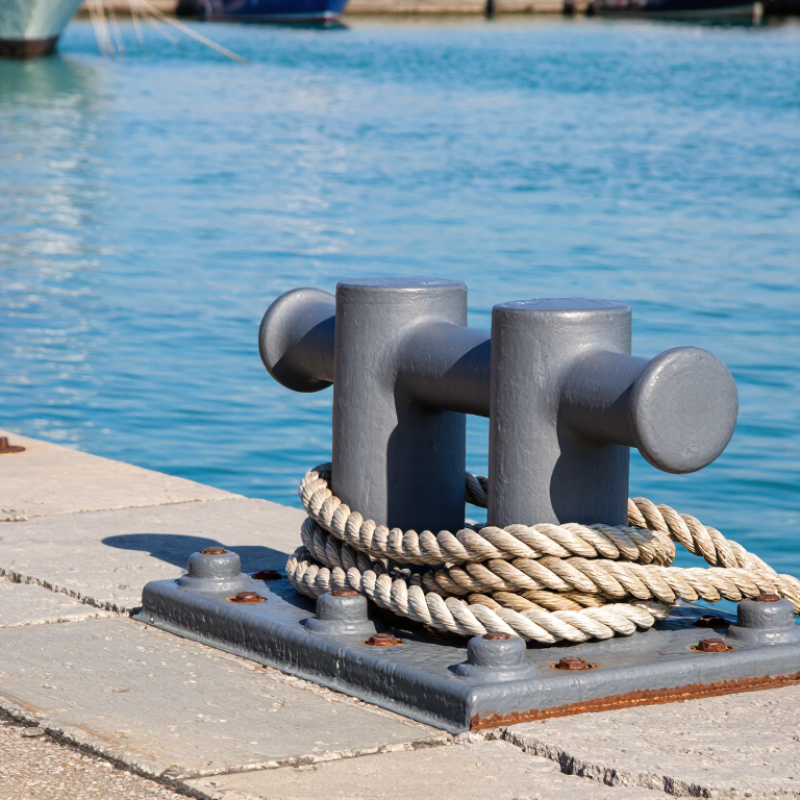
Tee-Head Bollard Anatomy: How Its T-Shaped Head Guides Mooring Lines
A tee-head bollard secures a vessel’s mooring line at a quay or berth. Its crossbar creates two projecting horns above a narrow stem. A line loop can sit over a horn, while a turn around the bollard helps hold tension. The raised ends help limit the loop slipping off as the vessel moves. Small detail. But the bollard does not guide a line like a pulley; the crew and berth layout determine its lead.
That shape matters when line direction changes with tide, loading, or wind. A deckhand may see the line angle shift against the steel, then adjust its position to avoid crowding other turns. OCIMF’s Mooring Equipment Guidelines, MEG4, stresses that line leads and snap-back hazards need careful assessment. A tee-head cannot make a poor line arrangement safe. Capacity, foundation strength, line type, and the vessel’s mooring plan all matter.
The scale of the task is global: UNCTAD’s Review of Maritime Transport 2024 reports that over 80% of world trade by volume moves by sea. Yet a bollard’s usefulness is decided at a specific berth, not by that statistic. Inspect for corrosion, sharp edges, loose foundations, and worn line-contact surfaces. It is easy to focus on the T-shaped head and miss the base. That deserves a second look.
Marine Mooring Loads: Check the Bollard’s Rated Safe Working Load (SWL)
A tee head bollard provides a secure point for mooring lines on docks, piers, and vessels. Its crossbar helps keep a properly placed line from slipping off. But the shape alone does not tell you how much load it can safely handle.
Check the bollard’s rated safe working load (SWL) before assigning a mooring line. Compare the rating with the expected line tension, including changes caused by wind, waves, vessel movement, and sudden loading. A calm berth can become demanding when a vessel surges against a tight line. Dynamic loads matter. The SWL should come from reliable product or engineering documentation, not a guess based on size or appearance. Also confirm that the rating applies to the actual mounting arrangement and load direction.
Inspect the full load path. A strong bollard can still fail if its bolts, supporting plate, or dock structure are inadequate. Look for corrosion, cracks, loose fasteners, and distorted metal; worn rating marks can be hard to read, too. Keep lines seated correctly around the tee head, and avoid side loading unless the design permits it. When the expected loads or installation details are uncertain, have a qualified marine professional review them. That extra check may feel cautious, but appearance is not a load test.
Industry Standard: ISO 13795:2012 for Ship’s Mooring Bollards
What Is a Tee Head Bollard Used For?
A tee head bollard provides a fixed point for securing a ship’s mooring lines. Its crossbar gives crew a place to pass and hold a rope, while the post transfers force into the deck structure. The shape is simple, but the loads are not. That matters at sea.
ISO 13795:2012, Ship’s Mooring Bollards, offers an industry reference for the design and specification of shipboard bollards. It helps owners, designers, and suppliers work from consistent technical requirements rather than relying on appearance alone. When assessing a tee head bollard, check the standard’s scope and the relevant drawings for its dimensions, construction, and applicable requirements. A familiar shape does not prove that a fitting suits every vessel or line arrangement.
Compliance is only one part of safe use. The bollard must be correctly installed, maintained, and matched to expected mooring loads. Inspect for corrosion, cracks, loose fasteners, or damage around the deck foundation. Small defects can matter. Operational conditions also change, and real-world line loads may not match a simple estimate. Fit still matters.
Installation Factors: Foundation Strength, Line Angle, and Rope Chafe
A tee head bollard secures mooring lines where crews need a clear, accessible tie-off point. Its crossbar helps keep a looped rope in place, but the bollard is only as dependable as its foundation. Concrete thickness, reinforcement, soil conditions, and nearby edges all affect how loads transfer into the ground. A fitting that feels solid by hand may still shift under a heavily loaded line. Small movements matter.
Before installation, check the expected line pull and the direction it will act. A line approaching at a sharp sideways angle can place uneven force on the bollard and its anchors. Where possible, position the fitting so the rope leads smoothly toward the vessel or secured load. Site layouts are not always ideal, of course. If the line must turn, evaluate the load path rather than assuming the bollard can take it.
Rope chafe deserves equal attention. Look for rough welds, sharp corners, damaged coatings, and contact with nearby deck edges. A rope can wear quickly when it rubs at the same point under tension, even if the bollard itself remains undamaged. Check contact areas during routine inspections, especially after heavy use or weather exposure. The right placement helps, but it cannot prevent every wear pattern; actual rope movement may reveal problems that a drawing misses.
Typical Applications: Securing Vessels at Docks, Quays, and Piers
A tee head bollard provides a secure point for mooring vessels at docks, quays, and piers. Its wide crossbar gives crews room to pass a rope around the head and adjust its position. A line can be led from different directions, which helps when boats approach or leave at changing angles. The rope should sit properly on the bollard, not ride over a sharp edge.
On a working quay, bollards may serve small craft, service boats, or larger vessels, depending on their rated capacity and installation. The bollard’s foundation matters as much as its visible shape. Loads travel through the fitting into the supporting concrete or steel, so capacity should match the vessel, mooring arrangement, and expected forces. Not every berth needs the same size.
Good placement also leaves room for safe rope handling and keeps lines clear of walkways where possible. Crews should check for corrosion, cracks, loose fasteners, and rope wear around contact points. A bollard can look sound while its anchorage is weakening. That detail is easy to overlook. Mooring lines also need suitable angles and enough allowance for tides, wakes, and vessel movement; a tidy setup at low water may behave differently later.